
A Sovereign AI Solution for Employee and ID Photos: 100% Swiss, 0% U.S. Cloud
Anyone who wants to digitally capture photos of people in a business or government setting faces a fundamental question: Where is this sensitive data processed—and who owns the technology behind it? Photo Collect provides a clear answer: The AI was developed in-house, is owned by Photo Collect, and runs entirely in Switzerland. No U.S. cloud, no CLOUD Act risk, and no compromises on data sovereignty.
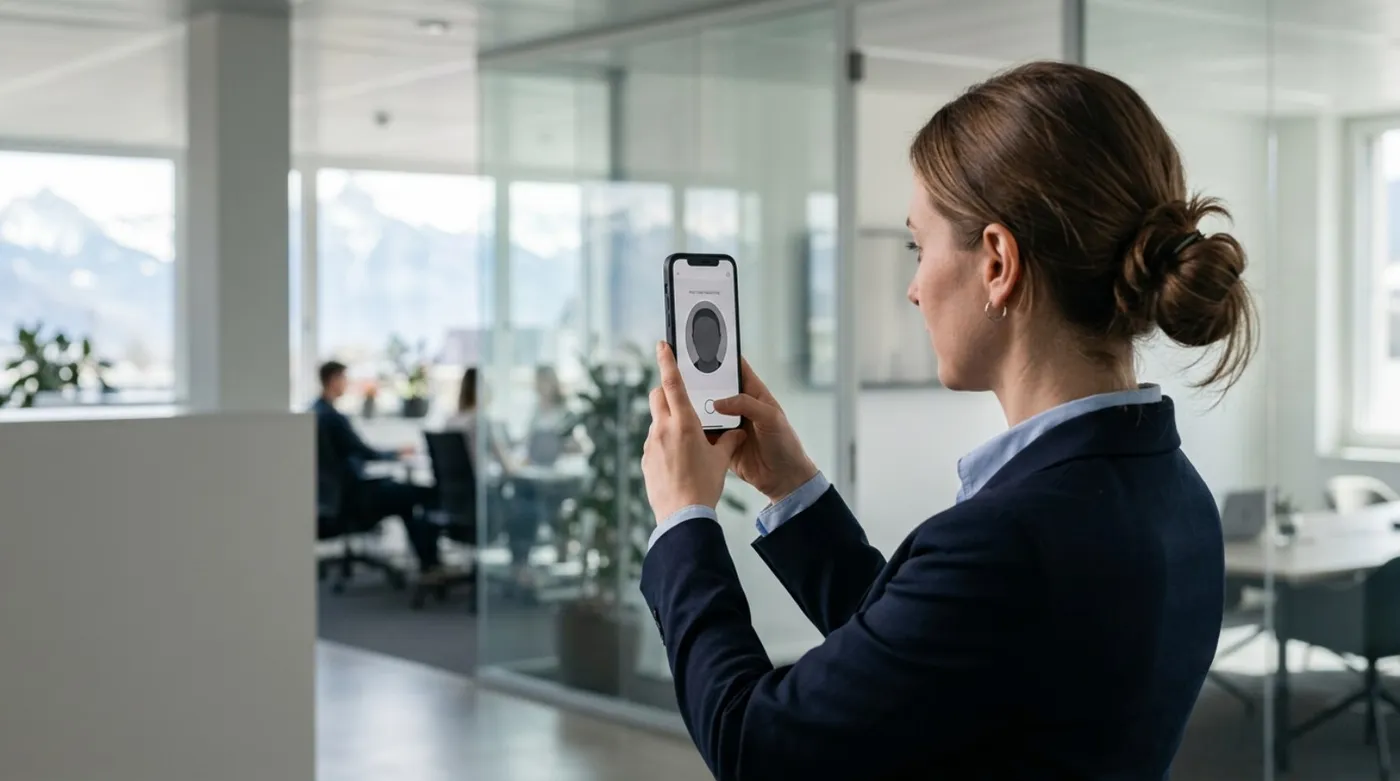
Employee photos for badges, ID photos for government agencies, photos for access cards or student IDs: These always involve biometric personal data linked to names and employee ID numbers. For companies with compliance requirements, government agencies, and critical infrastructure organizations, it is therefore not only important how efficiently a photo platform operates, but also where and under what legal framework it does so.
What does digital sovereignty mean in the context of photo capture?
Digital sovereignty means that you retain complete control over where your data is processed, who can access it, and which laws govern it. When it comes to capturing employee and ID photos, this applies to three levels:
- Storage location: Are the photos stored in a Swiss data center or with a U.S. hyperscaler?
- Legal Framework: Global cloud providers are subject to extraterritorial laws such as the U.S. CLOUD Act. This law can grant U.S. authorities access to data stored on servers belonging to U.S. providers—regardless of whether those servers are located in Zurich or Virginia.
- Technology Ownership: Who owns the AI models that analyze your photos? Are the images shared with third-party AI APIs?
Many providers meet only the first level, at best. Photo Collect meets all three.
In-house AI instead of an off-the-shelf black box
The AI behind Photo Collect is not licensed from a U.S. tech company, but is entirely in-house. The models are owned by Photo Collect and perform three tasks for every photo uploaded:
- Facial recognition and biometric analysis: Head position, eye openness, sharpness, and resolution are automatically checked against ICAO and ISO standards.
- Content Classification: Sunglasses, covered faces, poor lighting, or prank uploads are detected and rejected with clear feedback. Taking a new photo takes just seconds; no one from HR or IT needs to intervene.
- Background segmentation: The subject is precisely isolated and placed against a standardized or company-specific background—ensuring a consistent look across thousands of employees.
The results in numbers: 5 times more usable photos compared to raw uploads, only 2 to 4 percent re-uploads after AI review, and a median time of less than 2 minutes from the invitation link to the finished, compliant photo. We’ve described how the optional quality control further ensures these results in a separate article.
Equally important is what the Photo Collect AI deliberately does not do: no generative AI is used. Photos are checked, cropped, and cut out, but never altered or artificially generated. Every photo shows the real person – the basic requirement for images suitable for biometrics and ID documents. We explain why we consistently rely on validation instead of image alteration in a separate article.
AI Hosting in Switzerland: No U.S. CLOUD Act, No Dependency
Ownership of the technology is half the battle when it comes to sovereignty. The other half is the infrastructure. Even the computationally intensive image processing—running AI models on GPU servers—takes place entirely in Switzerland at Photo Collect. We’ve already explained in detail what hosting in Switzerland means in general.
After testing data centers in Switzerland operated by global providers such as Microsoft Azure and Amazon Web Services, the company chose the public cloud offered by Infomaniak, an independent Swiss cloud provider. Three factors were decisive:
- Legal Clarity: All data remains in Swiss data centers operated by a Swiss company—without any risks of extraterritorial access.
- 99.99% availability: Critical for a service that reviews and approves photos in real time.
- GPU costs are 75% lower than those of global providers—funds that go directly toward further developing the platform.
"Our customers, especially those in regulated industries, need absolute certainty that their data is being processed securely and in compliance with regulations."Dr. Niklaus Holbro, co-founder of Photo Collect
The migration was carried out entirely in-house, in stages, and without a single second of downtime. Infomaniak provides details on this in a case study about Photo Collect.
Who would benefit from a sovereign photo solution?
A sovereign solution for employee and ID photos is needed wherever data protection is not an option but a requirement:
- Government agencies and administrative bodies that must capture ID photos in compliance with the law—such as the Road Traffic Office of the Canton of Bern, which replaced its analog driver’s license photo process with Photo Collect.
- Banks, insurance companies, and pharmaceutical firms, whose supervisory authorities require a documentable data flow – keywords: GDPR- and Swiss FADP-compliant processing, as well as new requirements such as NIS2 and DORA.
- Hospitals and critical infrastructure, such as the University Hospital of Basel, where access cards are essential for security.
- Industrial and large corporations such as the BMW Group or Migros, which need thousands of employee photos processed in a consistent manner and in compliance with data protection regulations—up to 20,000 employees in three weeks.
In every security and data protection audit, the answer to the question “Where are the photos processed?” is always the same for Photo Collect: 100% in Switzerland, in an ISO 27001-certified environment.
Sovereignty and efficiency are not mutually exclusive
Anyone looking for a sovereign alternative to U.S. cloud services today doesn't have to compromise on performance. Photo Collect combines both:
Requirements: Photo Collect Data Processing 100% Switzerland, ISO 27001 AI Models: In-house development, owned by Photo Collect U.S. CLOUD Act: No risk—no U.S. providers involved Generative AI: Deliberately not used; faces remain unchanged Standards: ICAO- and ISO-compliant Time per photo: Less than 2 minutes (median) Availability: 99.99%
Conclusion: Sovereign AI is an architectural decision
Digital sovereignty cannot be tacked on after the fact. It begins with the question of who owns the technology and ends with the question of where the last GPU server is located. Photo Collect consistently answered both questions: its own AI models, its own expertise, and Swiss infrastructure.
For companies, government agencies, and institutions, this means the efficiency of automated AI review—and the assurance that not a single photo leaves Switzerland.
Are you looking for a sovereign solution for employee or ID photos? Contact us for a demo – from the invitation link to an ICAO-compliant photo in under 2 minutes.